Continue to Pester, Nag and Bite by Martin Gilbert
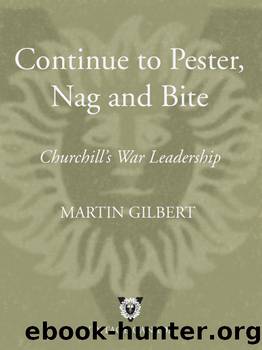
Author:Martin Gilbert [Gilbert, Martin]
Language: eng
Format: epub
ISBN: 978-0-307-36923-9
Publisher: Random House of Canada
Published: 2004-09-15T00:00:00+00:00
Churchill had enormous powers, both as Prime Minister and as Minister of Defence. Because he had established a National Government (he called it the âGrand Coalitionâ) and had brought members of all political parties into the highest positions, parliamentary opposition was effectively limited to a handful of malcontents whose dissatisfaction focused more on their exclusion from influence than on specific policies. But Churchill was careful not to abuse the power he had accrued. Reflecting on his new-found authority, he wrote, almost a decade later: âPower, for the sake of lording it over fellow-creatures or adding to personal pomp, is rightly judged base. But power in a national crisis, when a man believes he knows what orders should be given, is a blessing.â Twenty-five years earlier, when he had been forced out of office during the Dardanelles campaign, Churchill had written to his wife, âGod for a month of powerâand a good shorthand writer.â In 1940 he had both power and good shorthand writers; and he was to be Prime Minister not for a month but for almost five years.
Central to Churchillâs war leadership was his concept of the offensive: the need, as he saw it, to attack whenever possible, even when being attacked. The bombing offensive against Germany was a case in point: in its early stages it was relatively ineffective, and yet, from Churchillâs perspective, it constituted something that could be done, and could be seen to be done, to show that Britain did not have to sit back and accept whatever Germany might throw against it. In December 1939, while still at the Admiralty, Churchill had written to a War Cabinet colleague with regard to his own much postponed plan to drop aerial mines into the River Rhine to disrupt German military barge traffic: âThe offensive is three or four times as hard as passively enduring from day to day. It therefore requires all possible help in early stages. Nothing is easier than to smother it in the cradle. Yet here perhaps lies safety.â That same month Churchill wrote to the First Sea Lord: âAn absolute defensive is for weaker forces,â and he added: âI could never be responsible for a naval strategy which excluded the offensive principle.â He was delightedââI purred like six cats,â he later recalledâwhen General Wavell sent him a plan for an attack in the Western Desert in November 1940: âAt long last we are going to throw off the intolerable shackles of the defensive,â he told General Ismay, and added: âWars are won by superior will-power. Now we will wrest the initiative from the enemy and impose our will on him.â
Anything that smacked of passivity on the part of his army commanders incurred Churchillâs wrath. Learning at the beginning of November 1941 that nothing âlargeâ was being planned against the German and Italian forces in the Western Desert by Wavellâs successor, Churchill wrote to his former Boer War adversary, General Smuts, then a respected voice in Allied military circles: âI dread the idea
Download
This site does not store any files on its server. We only index and link to content provided by other sites. Please contact the content providers to delete copyright contents if any and email us, we'll remove relevant links or contents immediately.
| Africa | Americas |
| Arctic & Antarctica | Asia |
| Australia & Oceania | Europe |
| Middle East | Russia |
| United States | World |
| Ancient Civilizations | Military |
| Historical Study & Educational Resources |
The Radium Girls by Kate Moore(12089)
100 Deadly Skills by Clint Emerson(4968)
Rise and Kill First by Ronen Bergman(4833)
The Templars by Dan Jones(4732)
The Doomsday Machine by Daniel Ellsberg(4538)
The Rape of Nanking by Iris Chang(4255)
Killing England by Bill O'Reilly(4041)
Stalin by Stephen Kotkin(4003)
Hitler in Los Angeles by Steven J. Ross(3975)
12 Strong by Doug Stanton(3575)
Hitler's Monsters by Eric Kurlander(3384)
The Code Book by Simon Singh(3250)
Blood and Sand by Alex Von Tunzelmann(3238)
Darkest Hour by Anthony McCarten(3161)
The Art of War Visualized by Jessica Hagy(3042)
Hitler's Flying Saucers: A Guide to German Flying Discs of the Second World War by Stevens Henry(2777)
Babylon's Ark by Lawrence Anthony(2717)
Tobruk by Peter Fitzsimons(2559)
The Second World Wars by Victor Davis Hanson(2553)
